‘Innovation’ is a word that gets bandied around a lot. We’re guilty of it too, because the truth is, it forms the entire fabric of how we operate, deliver and grow.
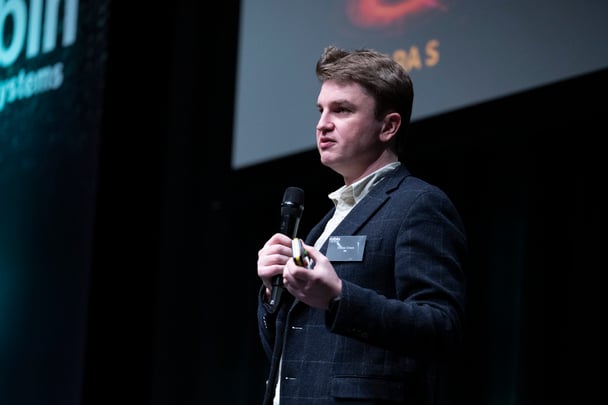
It’s far from a buzz word in our world, though. We took the chance to sit down with our Chief Technology Officer, Vivien Croes, to unpick what it really means to Robin.
Innovation is tension
“I often have to move twenty times a day between strategy-level decisions and deep technical details,” explains Vivien. It’s one of the things he loves most about his role.
“One moment I’m supporting long-term architectural choices, the next, diving into precise human or organisational issues. That variety gives me energy, and it’s not dissimilar to the balance we strike constantly in our technical team.
Innovation happens between fields, pivoting between details and helicopter views. It never happens in a vacuum or comes from a single source. It happens in grey space.
Real innovation means striking a balance between competing demands. Innovation lives in that tension. It’s how we build something the market needs before the market even knows it, at standards that defy time.”
At Robin Radar Systems, that’s an embedded philosophy. We combine deep technical expertise, multidisciplinary thinking, real-world validation, and the courage to move fast.
From rocket engines to radar systems
French by origin, Vivien has lived and worked across Germany, the UK, Belgium and now the Netherlands, and technology has never been far from reach.
“I grew up with rockets roaring overhead,” Vivien tells us. “My father worked in aerospace for 35 years. One of my earliest memories involves the physical force of rocket launches rumbling through our home, shelves clattering, furniture shaking, as they launched towards the ocean.
I collected pieces of the first Ariane 5 that had exploded. I still have some of them. From very early on, I just wanted to understand how things work.”
That curiosity led Vivien to a PhD in applied physics and a career in the aerospace sector, working across complex satellite systems, from thrusters to electronics. After years in space technology, he began looking for a new frontier.
“I wanted something high-tech, but different. I’m still serving as a reserve officer in the French Navy, and that connection to defense technology drew me toward radar.
I liked that radar is a subsystem in a much larger one, and the radar side itself demands a whole symphony of expertise. RF engineering, mechanics, electronics, firmware, software, data science, AI. You need real depth in each domain, but you also need to orchestrate them.
That’s a challenge I found hard to resist.”
Leadership done differently
Managing, harmonising and layering that degree of specialist knowledge can be a challenge.
Not only is Robin diverse in skillset, it’s diverse full stop. With 35 nationalities and counting forming the company, all teams are truly international.
“That’s certainly an exciting part of this company’s strength and culture,” says Vivien. “It brings a huge breadth of thinking into play, but only if it’s led in the right way. It takes more effort to converge, but we become far more robust and creative. Diversity of viewpoints helps you avoid mistakes.
We tend to fight micromanagement here. My role is to provide clarity about where we’re going and what the expected outcome is, not to define the steps that bring us there. I experience that if people internalise the intention, they often find much better solutions than if I prescribe the method.”
Innovation at pace
At Robin, innovation is grounded in speed. We shorten cycles, learning fast to deliver what the market needs, sometimes even before it knows it.
“Our job is to find the sweet spot between what we can technically achieve and what the market expects. But the market is never our only compass. The key is clarity. We define strong priorities at leadership level, and they always look ahead.
However, we work with tensions constantly. Most of our customers are working with urgency. They need rapid innovation cycles, but our systems must also meet the highest standards and certifications.
We bridge the gap with constant collaboration. Short innovation cycles are sustained with selected customers who agree to test systems in development. Product management then cherry-picks outcomes and feeds them back into structured productisation.
We go as fast as possible. Test, test, test. Correct and go again. We don’t spend ages perfecting theories at Robin.
And of course, every choice is a compromise, you cannot do everything.”
Innovation in practice
IRIS On-The-Move (OTM) and Long-Range Mode (LRM) are both outcomes.
“OTM started with a customer asking: can we use the radar while driving? That opened a huge scope of technical challenges. We experimented in the field, defined a working solution, and once proven, industrialised it.”
LRM pushed the boundary further. “With Long-Range Mode, customers get the option to see much further, achieved through AI training alone without changing hardware. Five years ago, that would have sounded laughable.”
Vivien explains that this is just the beginning. “We’ll continue to leverage processing power, and AI, to keep making breakthroughs. Initially, we used machine learning to enhance classification, but detection and tracking will increasingly be handled by AI or hybrid architectures.
We have a strong culture of getting the job done. Our engineers are multidisciplinary, they need to see both the big picture and the detail. That’s important.”
A culture to match
Robin’s culture is built around delivery. We put hands on deck to get projects over the line and into the world.
“Though Robin has scaled aggressively, bureaucracy remains very close to zero. Our technology teams are given the freedom to solve problems, choose tools and create routes. That freedom is empowering, and we work hard to keep it in place across the board.
We aim to preserve that spirit of getting ideas off the ground, but we must still harness it right as we continue to scale. We must professionalise. Introduce frameworks and processes where needed. Prevent silos from forming. Keep clarity intact.
That’s a challenge, but an even bigger challenge for us right now is workload. We love what we do, and want to tackle everything at once.”
Admirable, but not always feasible.
“This is why building upon our current talent base is essential. Staying at the cutting edge is never a given, it requires constant consolidation and growth of high-level skills.”
Like Vivien and his team, are you energised by complexity, driven by impact and ready to build technology still unimagined by the market? We’d love to meet you.