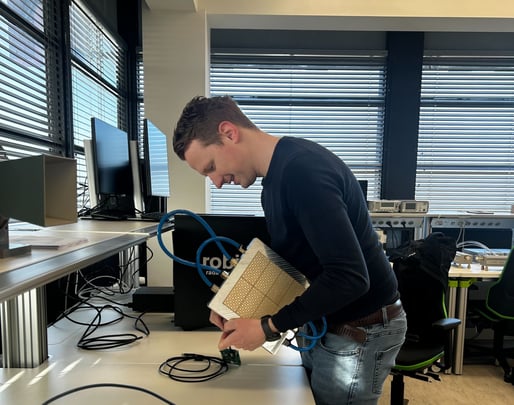
Robin Radar Systems has delivered the first TX tile prototype for PHARA, a first-of-its-kind advanced weather radar for Europe. Received by TU Delft in April, this inaugural hardware shipment marked a milestone moment for the highly advanced phased-array detection system.
Led by TU Delft, the PHARA project brings together a consortium of high-tech organisations to develop a fully 3D weather radar that can accurately track the movement and growth process of cloud particles and large-scale weather fronts, enabling deeper understanding of extreme weather incidents.
This initial TX tile represents one-fourteenth of the complete transmit phased-array antenna. With this crucial piece in place, the team at TU Delft can now begin first measurements on PHARA hardware.
“Delivering the first prototype to TU Delft enables accelerated research on polarimetric radars for weather applications. In partnership with TU Delft and with the help of the PHARA system, society can now push its understanding of atmospheric phenomena and validate the theoretical background of atmospheric process modeling.”
Guilherme Theis, Team Lead Antenna Arrays & RF, Robin Radar Systems
What the TX tile prototype facilitates
While traditional weather radars may take up to five minutes to scan the sky, a fully assembled phased-array antenna using TX and RX tiles can do the same thing in under a minute, giving crucial extra lead time during fast-moving severe weather events.
The TX tile prototype supplied is a modular, scalable building block for fast-scanning phased-array radar. Delivered alongside a workstation, chiller, and software, the prototype allows the team at TU Delft to begin measuring amplitude and phase from each single antenna element, as well as the full active tile array.
It also allows the team to check polarisations and pattern characteristics in different planes, see how they behave in relation to tile-probe relative orientation changes, and devise their own tests.
“The delivered TX tile represents the smallest, indivisible part of the final system, already showcasing some of its capabilities. After an extensive verification plan, and despite the delays encountered, we were able to confirm the communication chain and polarisation accuracy. This gives us a strong reason to believe we are on track and can now focus our efforts on the receiving tile.”
Bruno Sochacki, R&D Project Manager, Robin Radar Systems
The problem PHARA solves
With extreme weather events on the rise globally, the groundbreaking insights and full 3D resolution provided by PHARA will contribute to advancements in climate and atmosphere research and more precise weather forecasting.
In practice, the system is being developed to provide high-resolution data on the microphysical processes inside clouds and precipitation, which current instruments cannot.
PHARA achieves this by combining two powerful technologies: phased-array radar, which scans the atmosphere in multiple directions simultaneously, and polarisation diversity, which reveals shape, orientation, and phase of particles in clouds.
By integrating these two approaches, PHARA delivers a tenfold increase in update rate compared to conventional radars, while maintaining both range and Doppler resolution – enabling the precise tracking of rapidly evolving weather systems.
Technology built on collaboration
Bringing PHARA to life is a team effort. Working alongside Robin Radar Systems, the high-tech consortium pursuing this mission unites several organisations – TU Delft, TNO, KNMI, The University of Groningen, and ASTRON – with each contributing a unique specialisation to the collaboration.
As the first substantial PHARA hardware to arrive at TU Delft, the delivery of the TX tile prototype is a proud moment for the entire consortium. Next steps include the delivery of the RX tile, equipped with ADCs and fibre data transfer.