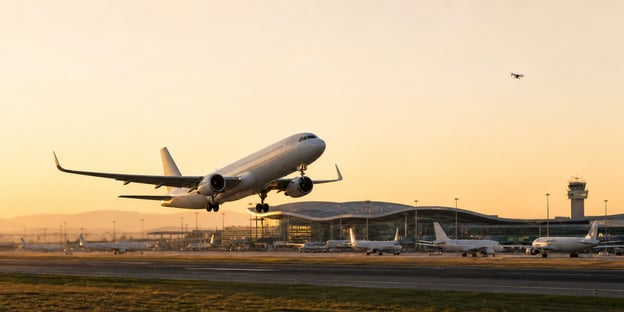
Airports are major transportation hubs that handle millions of travellers every day. In 2025 alone, the busiest in the world – Hartsfield-Jackson Atlanta International – recorded 106.3 million passengers in a single year, contributing to an estimated global total of 9.8 billion travellers.
With such a high volume of people to manage daily, plus employees, cargo, planes, and other assets, addressing safety and security remains a top priority for airport security teams.
Unmanned aircraft systems and airports
In recent years, the rise of low-cost, rapidly manufactured unmanned aircraft systems (UAS) and off-the-shelf commercial drones has posed unprecedented risks to aviation. To protect airspace and address these operational challenges, modern airports require specialised technology capable of detecting and mitigating unauthorised activity.
UAS have long been a concern. As early as 2016, the U.S. Office of Airport Safety and Standards (AAS) issued formal guidance and policy documents regarding counter-UAS radar detection and mitigation technology at airports.
Since then, Congress and the Federal Aviation Administration (FAA) have moved past theoretical guidance into active operational testing, strict safety reviews, and clearer legal boundaries.
For airport security teams, this evolution means that while non-interfering detection systems – such as specialised radar and RF sensors – can be systematically integrated into daily operations, active drone mitigation remains strictly governed by federal authorities.
To mitigate risk in the EU, European aviation authorities have expanded their defensive and regulatory frameworks too. Building on initial airport guidance from the European Union Aviation Safety Agency (EASA), the EU now mandates that most civil drone operators register, pass safety exams, and use drones equipped with direct Remote ID.
Alongside these operator requirements, new EU-wide counter-drone initiatives support airports in deploying detection technologies.
It’s clear, then, that looking beyond regulatory frameworks, airports must establish their own strategies to manage the ever-evolving threat posed by UAS. This starts with thorough risk assessment and stretches to the use of reliable detection systems.
Counter-UAS technology
Counter-drone and C-UAS technology encompasses a wide range of solutions that allow you to detect and classify drones.
At an airport, preventing UAS incidents requires 24/7, 360° coverage. This provides your ground teams with the full situational awareness they need to respond to threats. Your exact drone detection solution will depend on your airport's specific needs, and an experienced drone detection radar provider can help you establish what those might be. But in general, we recommend counter-UAS technology that can:
-
Accurately detect drones over a wide area (at least 3km)
-
Distinguish between UAS types and other objects, like birds
-
Locate threats in real-time, in shifting weather conditions
-
Track and monitor in real-time
-
Track multiple moving objects simultaneously
4 tips to upgrade counter-drone capabilities at your airport
Whether you're looking to add new measures, have existing systems or policies in place, or want to improve them, implementing effective counter-UAS radar and capabilities is essential, especially as UAS technology continues to evolve. Here's what you can do to improve measures and capabilities at your airport.
1. Understand the threat
Threat mitigation isn't just about technology, and your policy should extend far beyond the board room.
Implement a robust plan for educating your airport staff about the risks of UAS. Every member of your airport, such as the flight engineers, air traffic control officers, security guards, and even ground handling operatives, must understand the basic threat of UAS.
By doing so, any individual who is able to observe a drone will comprehend the potential security concern. The next step is to ensure they can easily report it through the relevant channel, such as your security team.
2. Implement surveillance systems
Drone monitoring equipment can be passive (simply looking or listening) or active (sending a signal out and analysing what comes back). There are a few types of drone detection solutions available, such as cameras, acoustic sensors, radio frequency analysers, and radar. The best providers use a combination of these, selected for your specific needs, to provide you with complete, comprehensive detection capabilities.
To distinguish between legal regulatory categories and unauthorised threats, it's important to adopt a solution that lets you detect and classify UAS. Under EASA guidance, authorised civil operations fall into three primary risk categories:
-
Open (low risk): Visual line-of-sight (VLOS) flights conducted by recreational users, photographers or light commercial operators flying CE-marked drones under altitude limits.
-
Specific (medium risk): Higher-risk operators exceeding standard limits, such as Beyond Visual Line of Sight (BVLOS) flights or cargo transport.
-
Certified (high risk): Operations presenting risks equivalent to manned aviation, requiring certified aircraft and licensed pilots (e.g., passenger air taxis or heavy payload delivery).
Establishing this baseline allows surveillance technology to immediately flag non-compliant threat profiles, such as custom home-built drones operating illegally.
Your teams must be able to distinguish between these risks. Some equipment like radio frequency analysers, can identify a particular model of drone, or even identify the drone’s or controller’s digital fingerprint. This level of identification is useful for prosecution purposes, if needed.
3. Deploy counter-UAS technology
Drone countermeasure equipment like GPS spoofers, high-powered microwave devices, and jammers exist, but their use is strictly limited to military and law enforcement agencies. This includes practices like disabling a drone, destroying a drone, or taking control of a drone. For commercial airports, deploying active countermeasures remains illegal due to the risk of interfering with air traffic communications and navigation systems.
Instead, implementing market-leading drone detection systems is by far the strongest and most effective way to manage your counter-UAS radar capabilities. These tools allow security teams to identify threats and execute operational mitigation procedures, such as pausing flights or dispatching ground response.
4. Collaborate with law enforcement
No UAS sighting should go unreported. As a legitimate threat to airport safety and security, it's important to closely collaborate with law enforcement to record every sighting and incident. It also helps you establish a clear procedure for managing UAS sightings.
At the local level, the EASA recommends collaborating with air traffic control and law enforcement agencies to:
-
Build a drone sighting reporting mechanism
-
Develop incident response protocols and procedures
-
Create a 'memorandum of understanding' that outlines the role of each party in the event of an incident
Improve your counter-UAS capabilities and make your operations safer
Security is a top priority at airports. By implementing a robust counter UAS system with the support of an experienced radar tracking technology leader, you have the tools needed to effectively counter the drone security threat.