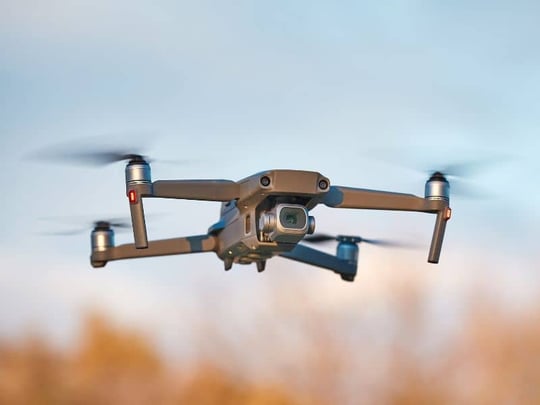
Micro-Doppler radar technology classifies drones by analysing the unique motion signatures of their spinning rotor blades.
Unlike traditional radar, which struggles to distinguish small drones from birds of similar size, micro-Doppler technology identifies the distinctive frequency patterns created by rotating propellers – enabling accurate classification and significantly fewer false alarms.
For security teams, airport operators, and defence planners facing the growing challenge of unauthorised drone activity, understanding how micro-Doppler technology works is essential.
The Fundamentals of Micro-Doppler Radar
| What is micro-Doppler radar? | How does it work? | Why does classification accuracy matter? | How does Robin Radar use it? |
| Micro-Doppler radar is a classification technology that identifies airborne objects by analysing the unique frequency patterns created by their moving components. For example, spinning rotor blades on drones. | It works by detecting micro-motion signatures – small frequency modulations caused by rotating propellers. These signals tell the radar whether the objects it sees are birds, drones, or clutter. | Strong classification performance allows ground teams to respond quickly and appropriately to drone threats, resulting in fewer false alarms and operator fatigue. | Our flagship IRIS drone radar combines micro-Doppler signature analysis with deep neural networks (DNN) – AI that learns patterns to identify and classify – to deliver reliable classification across a 360° area in full 3D. |
How Does Micro-Doppler Radar Work?
Drones use a system of propellers to stay airborne; birds beat their wings. Whilst these two distinctive modes of flight are obviously different to a human observer, traditional radar struggles to distinguish between them.
The reason is simple: drones and birds are similar in size, which gives them a similar radar cross-section (RCS). Traditional radar relies on RCS to detect and identify objects, which means drones and birds look much the same to these systems.
Micro-Doppler radar, like Robin Radar’s IRIS, overcomes this problem by focusing on the unique micro-Doppler signature drones emit during flight.
What is a micro-Doppler signature?
“Micro-Doppler is produced by the periodic movement of any structural component of an object. The periodic movement creates micro-motion, which in turn induces side-bands about the bulk Doppler frequency. The phase of the radar return signal from such an object (e.g. human walking, bird or drone flying) will change accordingly.”
– Nature
Automatic Classification
In practical terms, this means micro-Doppler radar can differentiate between the high-frequency modulation of a drone's spinning propeller blades (typically rotating at 50-100 Hz) and the lower-frequency periodic pattern of a bird's flapping wings (typically 4-10 Hz). These fundamentally different motion patterns produce distinct signatures that micro-Doppler radar can identify consistently.
With sufficient testing and data, micro-Doppler radar can build a comprehensive database of unique signatures for different airborne objects. This allows it to automatically classify airborne objects, discount non-drones, and warn you of potential threats in a range of conditions.

Why Accurate Drone Classification Matters
1. Reducing False Alarms
Because traditional radar can’t distinguish between drones and birds, they frequently generate false alarms from bird activity – overwhelming operators and wasting resources.
Research published in Frontiers in Communications and Networks has demonstrated that micro-Doppler classification using FMCW radar can reliably distinguish UAVs from non-UAV objects. That said, real-world performance depends on factors like radar settings, background clutter, and target characteristics.
Even with these variables, micro-Doppler radar represents a significant step up from traditional systems – giving you a much clearer picture of what's in your airspace, so you can focus resources on genuine threats rather than chasing birds.
Micro-Doppler radar can also identify tethered, hovering and autonomous drones – unlike radio frequency (RF) analysers, which rely on intercepting communications between a drone and its controller. If a drone isn't transmitting, RF systems can't see it.
2. Preventing Desensitisation to Threats
When operators are bombarded with frequent false alarms, they can become desensitised – a phenomenon known as "alarm fatigue." This poses a serious operational risk: if security personnel begin to treat every alert as another false positive, they may respond slower, or not at all, when a genuine threat appears.
Traditional systems that can’t distinguish drones from birds contribute directly to this problem. Micro-Doppler radar's high classification accuracy means operators receive fewer, more reliable alerts – helping teams remain vigilance.
3. Enabling Faster, More Appropriate Responses
Birds and drones require different responses. It would be unethical to use a net gun on a flock of endangered birds, but direct countermeasures are perfectly acceptable against potentially armed drones – especially in military contexts.
Micro-Doppler radar tells you what you're dealing with earlier and with greater certainty than traditional systems. So, you can prepare an appropriate response before a threat reaches its target – whether that’s continued monitoring or direct intervention via an RF jammer or net gun, for example.
Crucially, micro-Doppler technology can also track multiple fast-moving targets simultaneously, making it well-suited to monitoring drone swarms.
How Robin Radar Uses Micro-Doppler Technology
Robin Radar's IRIS drone detection radar combines 360° azimuth and 60° elevation coverage with micro-Doppler and deep neural network (DNN) classification. By analysing the unique rotor blade signatures of different drone types, it can reliably distinguish drones from birds – giving you the early warning you need to coordinate an effective response.
IRIS is mission-proven, with over 500 radars deployed worldwide to help protect and support:
- Airports
- Battlefield operations
- Military airbases
- Police forces
- Prisons
- Political summits
FAQs
What’s the difference between Doppler and micro-Doppler radar?
Standard Doppler radar measures the velocity of a target based on the frequency shift of reflected radar signals. Micro-Doppler radar picks up additional frequency modulations caused by moving components within the target, such as spinning rotor blades, enabling accurate and reliable classification.
Can micro-Doppler radar identify autonomous drones?
Yes. Unlike RF-based detection systems that rely on intercepting radio communications, micro-Doppler radar sees the moving components within the drone itself. If the rotors are spinning, the radar identifies the signature – regardless of whether the drone is transmitting or operating autonomously.
Does micro-Doppler radar work in all weather conditions?
Drone detection radar is inherently more resilient to weather than optical or acoustic alternatives. Whilst heavy precipitation can introduce some signal attenuation, systems with micro-Doppler classification capabilities, like IRIS, are tested and certified against military environmental standards (STANAG 4370) for operation in temperatures from -46°C to +50°C.
From how far can micro-Doppler radar classify drones?
Maximum classification range depends on drone size and radar specifications. IRIS can classify medium-sized drones weighing approximately 3 kg, at up to 2 km under typical conditions. A recent software upgrade extends the radar’s instrumented range from 5 km to 12 km for larger, fixed-wing drones.
The Drone Threat is Evolving – Can Your Systems Keep Up?
The first generation of mobile phones were large, bulky devices that performed a single function. It took many decades and countless iterations of the original design before they became the compact, versatile smartphones we know today.
Drones are on a similar evolutionary path. They're becoming smaller, smarter, and more accessible with each passing year. Marine Corps General Kenneth F. McKenzie Jr has described the proliferation of small, cheap drones as "the most concerning tactical development" since the improvised explosive device (IED).
As one of the only technologies that can reliably distinguish between small moving objects, micro-Doppler radar is becoming a key component of effective counter-drone strategies worldwide.