As the unfolding conflict in the Middle East has demonstrated, the counter-UAS gap is no longer a future problem. It’s a present crisis.
Events in the Gulf have brought to light what every SOF supporting element must plan against: an evolving threat landscape of one-way attack (OWA) UAS, loitering munitions, and ISR drones probing force positions before strikes.
This has proven lethal for both conventional forces and the forward support nodes that sustain SOF, including aviation staging areas, Maritime Special Purpose Force (MSPF) afloat platforms, and ground vehicle convoys.
As drone attacks on the U.S. and partner-force support elements surge in the Gulf, it’s clear we’ve entered a new era of aerial conflict – one that demands speed, agility, and adaptability.
At Robin, we’ve seen this firsthand across the Middle East and Ukraine, and we responded with IRIS.
Drone radar IRIS: built for a fight that doesn’t wait
Unmanned Aircraft Systems (UAS) have revolutionized the landscape of defense, security, and warfare. For SOF elements, this shift has compromised the traditional sanctuary of the shadows, introducing a constant risk of both persistent surveillance and lethal aerial strikes.
That’s why, when innovating our flagship 3D counter-UAS system, we purpose-built it for environments where weight, speed, and survivability are non-negotiable – engineering to address the challenges faced by modern SOF support elements operating in contested airspace.
The result: a low-SWaP, deployable radar that offers rapid setup and reliable performance.
-
Rapid deployment: Mission-ready in 15 minutes
Weighing just 64 lbs (29 kg), IRIS packs down and sets up quickly with an ultra-easy mount system. Ideal for Night Stalker FARP teams or MSOT vehicle packages, it can be easily loaded into the back of a SOCOM vehicle and deployed in austere environments.
-
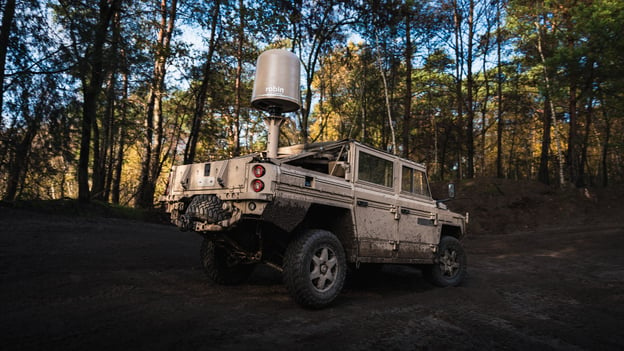
Vehicle-mounted on-the-move (OTM)
Mounted on vehicles, IRIS operates at speeds of up to 62 mph (100 km/h). That means coverage while moving through rugged terrain, protecting logistics convoys or rapid exfil columns with the same fidelity it provides at a static site.
-
Total situational awareness
IRIS offers total awareness. By combining 360° views, 60° elevation, and a 3-mile (5 km) instrumented range – extendable up to 7.5 miles (12 km) in Long-Range Mode (LRM) – it delivers a 30-mi² (78km²) total coverage area. A single IRIS unit can detect, track, and classify drone threats before they achieve engagement range.
-
24/7 detection
Micro-Doppler processing enables the classification of fixed-wing and hovering drones alike, operating equally in complete darkness. For Night Stalker teams, when operations are defined by darkness, IRIS doesn’t degrade when the lights go out.
-
AI-driven threat classification
Continuous upgrades using Deep Neural Networks (DNNs) have reduced false alarm rates by 80%, keeping operators focused on threats, not noise. Supported by AI, IRIS has tripled its classification range for small commercial drones, such as the DJI Mavic Mini 2.
Combat-proven detection: learnings from Ukraine
IRIS has not only been deployed across the Gulf, but has served as a first line of aerial defense in Ukraine for years. Delivered to frontlines in 2023 after an order from the Dutch Ministry of Defence (MoD), our radar has since seen hundreds of deployments across the country to protect Ukrainian forces on the ground.
A second order from the Dutch MoD in 2024 marked the introduction of our on-the-move (OTM) functionality, developed in response to a threat environment that was evolving faster than static systems could adapt.
The shifting operational hazards faced in Ukraine – drone swarms, one-way attack vehicles, mobile ISR platforms – are now manifesting in the Middle East. To keep up, we evolve at the speed of the threat, using a continuous software upgrade model driven by DNNs and trained on real-world engagement data.
Customizable intelligence: tuned for SOF support
No two SOF support environments are alike. IRIS recognizes this with operator-configurable parameters that allow mission planners to tailor detection behavior:
- In high-density airspace around a 160th SOAR staging area, sensitivity thresholds can be reduced to minimize false-alarm rates while maintaining critical classification ranges
- At a remote MSPF afloat platform or forward cache site, where the airspace is sparse, and any drone is a threat, sensitivity can be maximized to extend classification range by hundreds of meters.
- For Civil Affairs or PSYOP elements operating in semi-permissive urban environments, the radar’s DNN architecture will distinguish between drones, rotary-wing aircraft, fixed-wing aircraft, and ground vehicles.
Integration-first: IRIS at the center of the C-UAS stack
Mitigating drone threats with speed and precision takes a system of sensors.
IRIS is built as the first layer of aerial defense, designed for seamless integration with command and control (C2) systems and wider C-UAS architecture, allowing SOF support element commanders to take decisive action with confidence and speed.
Native integration for SAPIENT, ASTERIX, CoT/TAK, and numerous C2 systems comes with every IRIS radar.
Meeting the standard: USSOCOM modernization
As Pentagon policy has expanded counter-drone authorities for base commanders, and as USSOCOM accelerates its own C-UAS acquisition, we’re positioned to deliver a radar system that integrates rapidly into existing tactical networks.
In doing so, we’re meeting the technically rigorous standards that Navy Admiral Frank M. Bradley, Commander, USSOCOM, now expects of industry partners.
“To accomplish its goals and to continue protecting the nation… [SOCOM] requires accelerated modernization,” said Adm. Bradley during his FY2027 Posture Statement to the Senate Armed Services Committee. “Predictable resourcing for our program’s modernization is a strategic necessity.”
The innovation cycle has become measured in days and weeks, not months and years. IRIS is ready to match that pace.